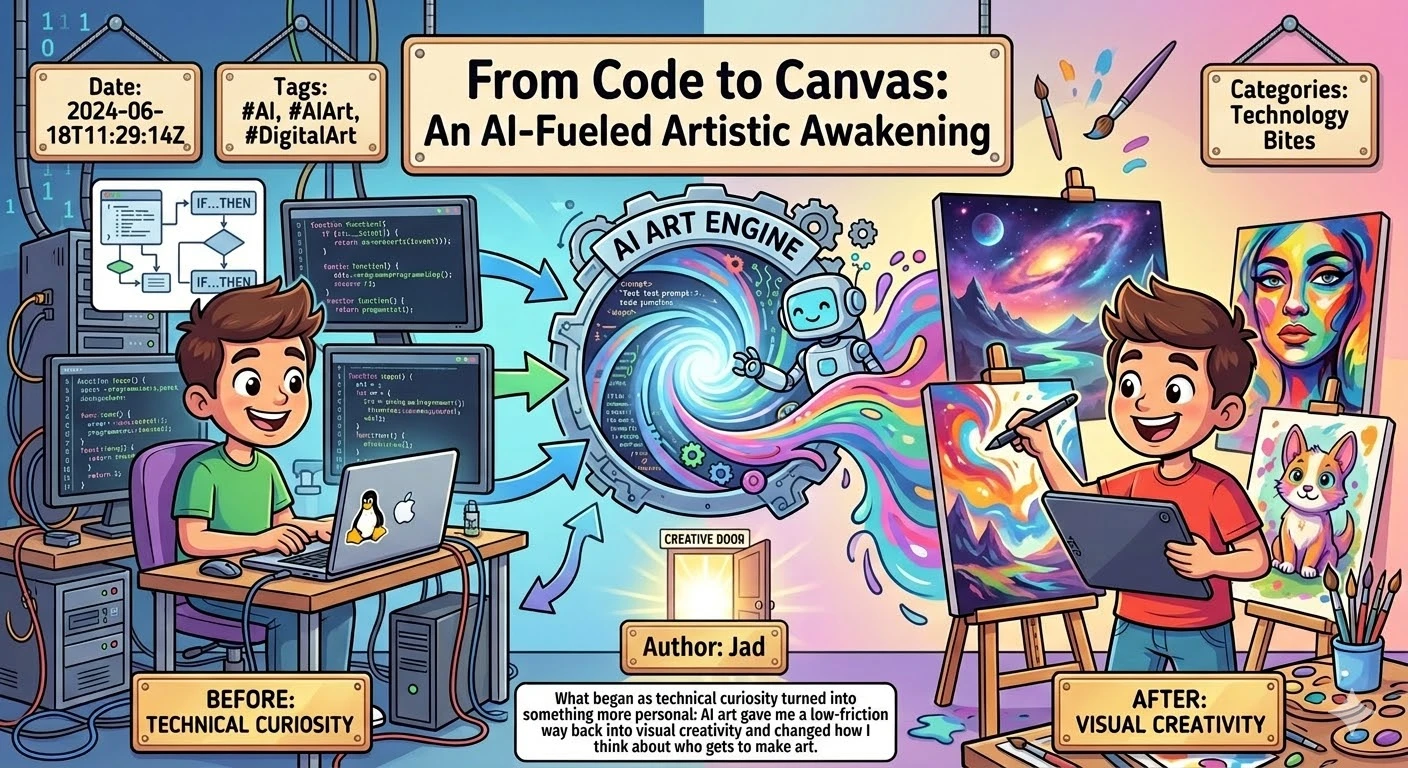
For most of my life, art was something I admired from a respectful distance.
I loved it. I could spend وقتًا طويلاً looking at an image, tracing mood and composition, and wondering how somebody managed to make a feeling visible. But admiration is not the same thing as participation. I never quite saw myself as someone who belonged on the making side of that equation.
Then AI image tools arrived, and something shifted.
Art Was Never Supposed to Be My Department
My comfort zone, historically, lived elsewhere: Linux boxes, code, systems, structure, technical problem-solving. That world made sense to me because it rewarded patience, experimentation, and a willingness to keep tinkering until the machine finally cooperated.
Art felt different. It seemed to belong to people with better instincts, better hands, more training, and a kind of confidence I did not grow up carrying in that domain.
So when I say AI art surprised me, I do not mean it impressed me as a novelty. I mean it disarmed a long-held assumption. It lowered the threshold enough for me to move from spectator to participant.
AI Lowered the Cost of Beginning
That is the part I think many people miss.
The most important thing AI did for me creatively was not perfect an image. It gave me permission to start.
Tools like Google Vertex and other image-generation systems offered something I had not really felt before in visual work: a low-friction sketchbook. I could begin with language, iterate quickly, test mood, color, framing, symbolism, and atmosphere, and get immediate feedback. Instead of facing a blank canvas with no bridge into it, I had a conversation partner that could turn vague intuition into something visible enough to refine.
That matters when you are creative but rusty, curious but undertrained, or simply intimidated by the cost of entry.
In that sense, this felt connected to the broader act of returning to older parts of myself online, something I wrote about in Rekindling the Flame: My Journey Back to Blogging After Two Decades. AI did not manufacture a new self out of nowhere. It reopened a door I had kept assuming was closed.
My Technical Background Turned Out to Matter
What surprised me most was how naturally my technical history translated into this new creative workflow.
Prompting is not the same thing as painting, obviously. But iteration, pattern recognition, constraint-setting, and curiosity about systems all transfer remarkably well. I found myself approaching image generation the way I have often approached software: try something, inspect the output, change one variable, observe what moves, and keep going until the result starts to feel intentional.
That process made AI art feel less like a gimmick and more like a new interface between imagination and execution.
It also reminded me that disciplines are rarely as separate as we pretend. Code and art do not sit on opposite sides of a wall. They overlap in process more than in status. Both ask you to notice structure. Both reward experimentation. Both require taste, even when the tools do part of the heavy lifting.
Democratization, With a Few Honest Caveats
I do think AI art democratizes creativity in meaningful ways. It gives more people access to image-making. It reduces intimidation. It allows people who have ideas but not formal training to explore visual expression without waiting years for technical mastery just to begin.
That is a real cultural shift, and I think it is mostly a good one.
But I am not interested in romanticizing it either.
AI does not eliminate questions of authorship, taste, originality, or ethics. It does not make every generated image meaningful. And it certainly does not make human artists obsolete. If anything, the flood of easy output makes discernment even more important. The question becomes less “Can you generate something?” and more “Do you know what you are trying to say?”
That is where the human being stubbornly remains in the frame.
From Code to Canvas, and Back Again
What I like about this whole experience is that it did not force me to choose between my technical self and my creative self. It made me realize they had been in conversation all along.
The same curiosity that once kept me awake fiddling with Linux systems is now part of how I explore composition, texture, and mood. The tooling changed. The impulse did not.
And maybe that is the deeper gift here. AI art did not turn me into a traditional artist overnight. It gave me a workable path into making things I previously thought belonged to somebody else.
That is not trivial. That is a form of permission. And sometimes, creatively speaking, permission is the difference between a dormant interest and a real practice.
Recommended
Continue reading
Selected from shared topics, related tags, and the recent archive.