I remember the first time I heard the wail of an air raid siren. It was 1990, during the Gulf War. Jordan is a profoundly calm and safe country, not just in comparison to our turbulent neighbors, but by almost any global metric. Yet, on that particular morning, the quiet of our neighborhood was shattered by a mechanical howl that seemed to shake the limestone under our feet.
To understand what happened in that moment, you have to understand what a 7ara is.
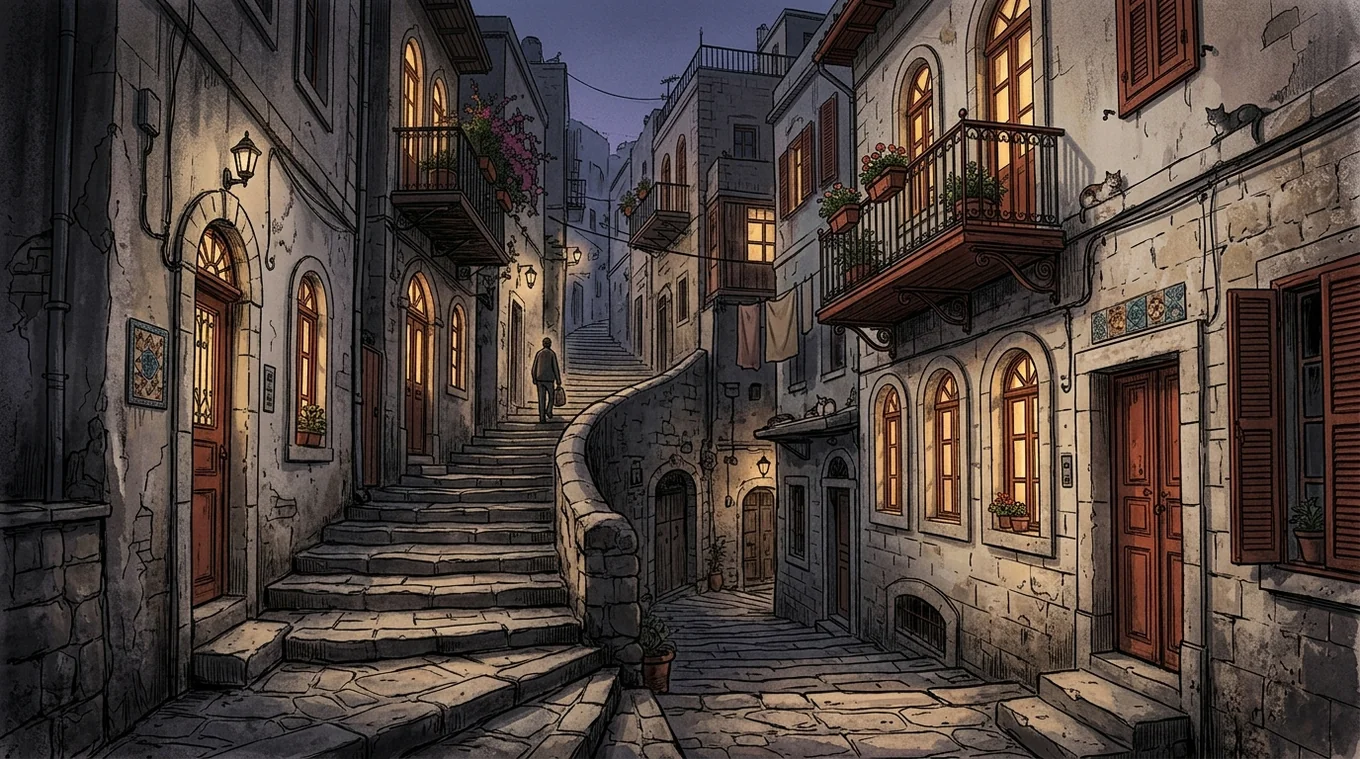
In Arabizi, a 7ara is a neighborhood alleyway, but the word carries a weight that “street” or “lane” can never capture. In the older quarters of Jabal Amman, a 7ara is a dense labyrinth of narrow passages woven through steep hillsides, often terminating abruptly in stone staircases that drop into dead ends. Ours was one of those stair-step alleyways. It was originally settled by families who had migrated from Ras El Ain, creating a tight-knit micro-community where everybody knew everybody down to the grandparent level.
When that 120-decibel siren echoed through the gorge of Jabal Amman, we didn’t check a screen. We didn’t open an app. We stepped out onto the stone stairs.
The Physical Acoustic Network
What struck me then, and what stays with me thirty-five years later, was the immediacy of shared human presence.
When the siren blew, fear wasn’t an isolated cognitive event; it was a physical wave that traveled from balcony to balcony. Shutters flew open. Elders called down to children playing five steps below. Neighbors who had been arguing over property lines the evening before were suddenly standing side by side on the stairs, scanning the horizon together.
In our 7ara, the physical architecture dictated our emotional architecture. Just as geography and network edge topology shape our digital reality today, the stone staircases of 1990s Amman acted as a physical broadcast network. Fear was raw, instinctual, and immediately processed in community. You saw the pale face of the baker; you felt the reassuring hand of an uncle on your shoulder. You were afraid, but you were never afraid alone.
From Air-Raid Siren to Push Notification
Fast forward to 2026. The sirens still sound across the region, but the nature of how we experience threat has undergone a silent mutation.
Today, the warning rarely arrives as an acoustic howl echoing through a stone alleyway. It arrives as a haptic buzz in your palm. A breaking news push notification from an app hosted on edge. A live strike-watch stream embedded in an X feed.
The modern siren is silent, persistent, and entirely solitary.
When a crisis unfolds now, we don’t step out onto the stairs to look our neighbors in the eye. We tilt our heads downward into glowing glass rectangles. Where the 7ara once pooled our collective anxiety into shared human solidarity, digital infrastructure atomizes us. Ten people can sit in the same living room in Amman, each receiving different live updates, different video clips, and different threat levels simultaneously.
Have We Become Emotionless, or Are We Bracing?
This shift raises an uncomfortable question for those of us living in the Middle East: Why aren’t we afraid the way we used to be?
When the siren sounded in 1991, it stopped life completely. It interrupted Friday morning breakfasts and forced a pause. Today, news of incoming strikes or regional escalation barely interrupts a conversation. People skim the alert, swipe it away, and return to writing code, editing video, or sipping coffee.
Are we becoming emotionless? Have decades of algorithmic outrage and continuous breaking news feeds desensitized our nervous systems?
I don’t think it’s numbness. I think it is an adaptive psychological buffer. When crisis becomes ambient background noise, the human mind builds its own firewalls. If we reacted to every push notification with the visceral terror we felt on the staircases of Jabal Amman in 1991, we wouldn’t be able to function, build, or live.
Yet something precious is lost when the siren shifts from a community event to a private notification. On the stone stairs of the 7ara, fear produced connection. In front of the smartphone screen, fear produces isolation.
As we continue building digital tools and shaping our local technological landscape, I find myself thinking back to those stone stairs. The challenge of our time isn’t just surviving the noise of the modern world: it is remembering how to step out onto the balcony together when the siren sounds.
Recommended
Continue reading
Selected from shared topics, related tags, and the recent archive.